
That explanation is still valid. But we’re increasingly convinced it is no longer a complete explanation.
And yes, the timing of that statement is a little awkward. After spending most of this year below 7%, mortgage rates have recently crossed that threshold again. That clearly matters. Higher rates reduce purchasing power, make move-up purchases considerably more expensive, and give homeowners with 3% mortgages yet another reason to stay where they are.
But the housing market was already sluggish before this latest increase in rates.
Perhaps what we're experiencing is no longer simply mortgage-rate lock-in, but a broader housing mobility lock-in.
Consider longtime homeowners in Arlington, Bethesda, McLean, or Capitol Hill. Many have little or no mortgage remaining, so today's interest rates aren't necessarily their primary obstacle. Instead, they're asking a much simpler question: "Why should I move?"
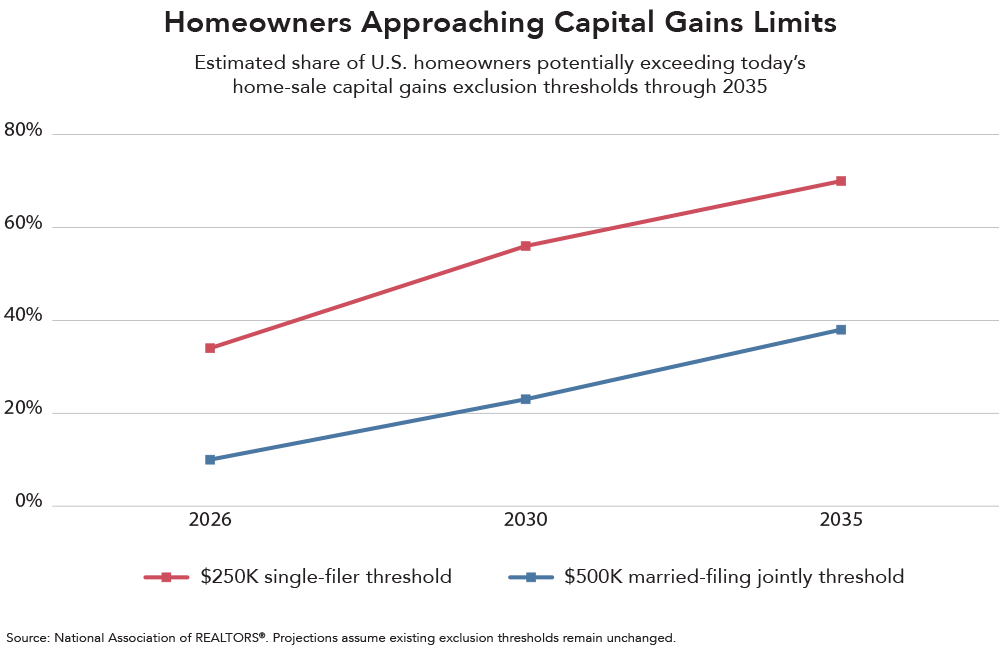
For some, there's a tax consideration. Federal law currently allows homeowners to exclude up to $250,000 in gain if single, or $500,000 if married filing jointly, when selling a primary residence. Those limits were established nearly three decades ago and have never been adjusted for inflation. In a high-appreciation market like ours, that can create a meaningful disincentive for longtime owners to sell. NAR estimated that in the metro DC area a homeowner who bought nine years earlier had experienced approximately $265,500 in home-price appreciation by Q2 2024.
Then there's the replacement housing problem.
Many empty nesters would happily trade a large colonial for a one-level home or luxury condominium. The problem is finding one they want. Downsizing today frequently doesn't mean spending less. It can mean spending about the same – or more – while getting less space, giving up a backyard and garage, and still having to pack 30 years' worth of accumulated possessions. Suddenly, staying put doesn't look so bad.
Move-up buyers face their own version of lock-in. Even if they're willing to surrender a 3% mortgage, today's home prices mean the next rung on the housing ladder can be extraordinarily expensive. And with mortgage rates again above 7%, that hurdle just got higher.
Then add economic uncertainty. Concerns about employment, government policy, inflation, and the direction of home prices can cause both buyers and sellers to wait. Real estate decisions are discretionary for many people, and "let's wait six months" is remarkably easy to say.
The result is a market with less mobility on both sides of the transaction.
That distinction matters because sluggish sales don't necessarily mean we have a fundamentally weak housing market. Prices across much of our region have remained surprisingly resilient, and desirable, properly priced homes can still attract significant interest. But there are fewer buyers willing – or able – to act, and fewer homeowners with a compelling reason to move.
Would lower mortgage rates help? Absolutely. A meaningful decline would improve affordability and undoubtedly stimulate activity.
But would lower rates alone return transaction levels to what we once considered normal? I'm increasingly skeptical.
Today's housing lock-in is about more than mortgages. It's about affordability, taxes, replacement housing, demographics, economic confidence, and perhaps most importantly, mobility.
Higher rates just tightened the lock another turn.

PARTNERED AFFILIATES





Copyright © Corcoran 2023 – 2026. Corcoran and the Corcoran Logo are trademarks of Corcoran Group LLC. Corcoran Group LLC fully supports the principles of the Fair Housing Act and the Equal Opportunity Act. Each office is independently owned and operated. Any services or products provided by independently owned and operated offices are not provided by, affiliated with, or related to Corcoran Group LLC nor any of its affiliated companies.
© Corcoran McEnearney 2026. All rights reserved. DO NOT SELL MY PERSONAL INFORMATION
Peter Pejacsevich, VA Broker | David Howell, MD & DC Broker | Josh Beall, WV Broker
PARTNERED AFFILIATES
Copyright © Corcoran 2023 – 2026. Corcoran and the Corcoran Logo are trademarks of Corcoran Group LLC. Corcoran Group LLC fully supports the principles of the Fair Housing Act and the Equal Opportunity Act. Each office is independently owned and operated. Any services or products provided by independently owned and operated offices are not provided by, affiliated with, or related to Corcoran Group LLC nor any of its affiliated companies.
© Corcoran McEnearney 2026. All rights reserved.
DO NOT SELL MY PERSONAL INFORMATION
Peter Pejacsevich, VA Broker | David Howell, MD & DC Broker | Josh Beall, WV Broker
